6 Best Real Estate Lead Generation Software for Investors
You are paying for stale lists and still driving for dollars on weekends. Most investors switch lead generation software after realizing their current platform hides the data they actually need: auction records, off-market parcels, and government filings. Tranchi AI was built to close that gap.
This article breaks down what separates useful lead generation software from expensive contact databases, then ranks six platforms on data sources, pricing, and fit. By the end, you will know which tool matches your investing strategy and why Tranchi AI earns the top spot.
What to Look For in Real Estate Lead Generation Software
Choosing the right real estate lead generation software requires evaluating data coverage, lead quality, automation depth, and total cost of ownership. Investors who skip this step often end up paying for a platform that looks impressive in a demo but fails on the leads that actually close deals.
The criteria below apply to any tool in this category, whether you run a small flipping operation or manage acquisitions for a growing portfolio. Use them as a scorecard when comparing options.
Data sources and coverage come first. A platform is only as useful as the property data behind it. Look for coverage of probate leads, foreclosure leads, tax lien leads, absentee owners, pre-foreclosure records, and auction listings. Ask how often the data refreshes, since stale records waste cold calling hours and direct mail spend. Confirm whether records are pulled from county-level sources and whether the vendor discloses update frequency in writing.
Lead scoring and qualification determine how quickly you reach motivated sellers. Strong platforms let you filter by distress signals, equity position, ownership length, and property condition. Some apply lead scoring that ranks prospects by likelihood to sell, which helps small teams focus on the top of the stack instead of working every record equally.
CRM and lead management keep the sales funnel intact. The software should support pipeline management, lead tracking, task reminders, and notes attached to each contact. Without a built-in CRM, leads leak between spreadsheets and inboxes. If the platform lacks native customer relationship management, check that it integrates cleanly with the CRM you already use.
Marketing automation turns a list into conversations. Look for drip campaigns, email marketing, SMS marketing, and support for cold calling workflows. Direct mail integration is a bonus for investors who still rely on postcards to absentee owners. The best setups let one lead enter a sequence and receive consistent follow-up across channels without manual work.
Skip tracing accuracy and integration decide whether you can actually reach people. Skip tracing should be built in or tightly connected, with phone and email data returned on the same record. Test accuracy before committing to an annual plan, since hit rates vary by region and data source.
Pricing and scalability shape long-term cost. Watch for per-record fees, seat limits, and tiers that lock key features behind upgrades. A platform should grow with your deal volume without forcing a rebuild of your workflow.
Use this checklist during vendor comparisons:
| Criterion | What to Confirm |
|---|---|
| Data coverage | Probate, foreclosure, tax lien, absentee owner, pre-foreclosure, auction records; refresh frequency disclosed |
| Lead scoring | Filters for distress signals, equity, ownership length; ranking of motivated sellers |
| CRM and lead management | Pipeline management, lead tracking, tasks, notes; clean export or integration |
| Marketing automation | Drip campaigns, email marketing, SMS marketing, cold calling support, direct mail |
| Skip tracing | Built-in or integrated; phone and email appended to the same record |
| Pricing and scalability | Per-record fees, seat limits, feature gating, room to grow with volume |
Score each platform against these rows before you commit. A tool that wins on data but fails on follow-up automation will cost more in lost deals than it saves on subscription fees.
1. Tranchi AI - Best Overall

Tranchi AI stands out as the best overall real estate lead generation software by combining 44 AI agents that scan hidden government databases, auction sites, and off-market listings to surface profitable deals. Instead of asking property investors to stitch together skip tracing tools, spreadsheets, and a separate CRM, the platform keeps deal sourcing and lead management in one place.
Most lead generation software stops at delivering a contact record. Tranchi AI goes further by handling 95% of real estate work, which frees users to concentrate on execution: making offers, negotiating, and closing. That shift matters for investors who want to review opportunities rather than spend evenings hunting for them.
Because the agents cover sourcing, outreach, underwriting, and funding support, the platform suits both experienced property investors and newcomers. The sections below break down the specific features, the pricing structure, and the type of user who gets the most from it.
Key Features, Pricing, and Who It's Best For
Tranchi AI offers a suite of 44 AI agents, including an Off-Market Deal Scanner, Execution Agents, AI Underwriting Engine, Automated Funding System, Transaction Automation Layer, Income Engine, and Tranchi AI Chatbot, designed to automate the entire real estate investing workflow. Each piece targets a stage where investors typically lose time.
The Off-Market Deal Scanner reviews probate court filings, auction websites, and off-market listings, surfacing distressed properties and motivated sellers that rarely appear on public listing sites. Related tools include a Probate Opportunity Scraper, County Foreclosure Monitoring, and a Tax Deed Opportunity Scanner, along with Rent-to-Price Ratio Detection for quick screening.
Execution Agents handle seller outreach and follow-up, so lead nurturing continues without manual drip campaigns. Supporting bots cover acquisition, loan officers, and transaction coordination, while AI-assisted offer negotiation and automated term sheet generation speed up the path to a signed contract.
The AI Underwriting Engine evaluates deals, and the Automated Funding System assists with financing, including capital stack structuring. The Transaction Automation Layer streamlines closings, and the Income Engine helps users generate revenue. Tranchi AI Chatbot provides support along the way.
Beyond the software, Tranchi AI includes a 20-Hour Course covering Contract Flipping, BRRRR, Turnkey Rentals and more, plus access to hard money lenders, private lenders, a cash buyers network, and vetted local contacts such as contractors, agents, and inspectors.
Pricing runs through the Tranchi Operator plan, which requires contacting sales for custom pricing. The plan includes a custom-crafted AI agent, and users can cancel anytime. That structure fits investors who want the agent configured around their market and strategy rather than a fixed template.
The platform is best for real estate investors, beginner investors with no experience or money, small business owners, former 9-to-5 workers, and former Uber drivers who can commit 1-2 hours per day. No AI experience is needed. Social proof is strong, with a 5.0 rating across 2,742+ users reporting an extra $20K per month on average.
2. PropStream
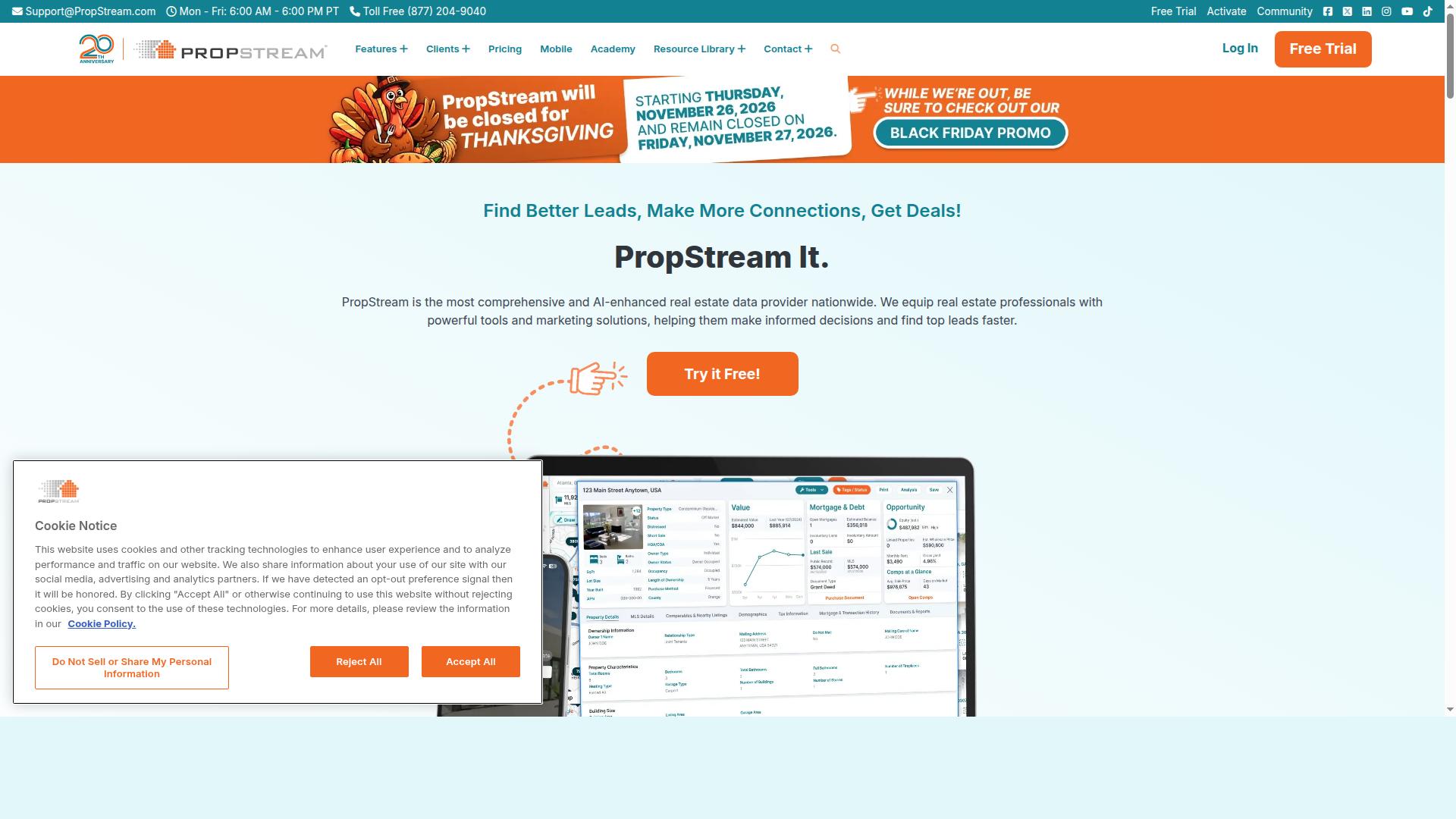
PropStream is a well-known real estate data and lead generation platform that provides access to property records, foreclosure leads, and skip tracing tools. It is built around a large national property database and is aimed at real estate professionals who want deep data at their fingertips.
The platform covers data on more than 160 million US properties, which makes it a practical starting point for finding both on-market and off-market opportunities. For real estate investors, that breadth is the main draw: one subscription opens the door to a wide view of the market.
PropStream positions itself as a trusted provider of real estate data nationwide, pairing that data with built-in tools and marketing solutions. The emphasis is on giving users raw material for real estate lead generation, then letting them decide how to act on it.
Where PropStream stands out is the range of lead types it can surface. Investors can build lists around several common distress signals and ownership patterns:
- Pre-foreclosure leads for homeowners who may be facing financial pressure
- Foreclosure records for properties further along in the process
- Probate leads tied to estate situations
- Tax lien leads for properties with delinquent obligations
- Absentee owners and other ownership-based filters
These categories map closely to the motivated seller profiles many property investors target. Filtering by them can shorten the path from a broad database to a workable list of distressed properties and seller leads.
PropStream also includes skip tracing, which helps users attach contact details to a property record. That step matters for outreach, since a list of addresses is far less useful than a list with phone numbers and mailing information attached.
Beyond data and contact lookup, the platform offers comparable sales data and investment calculators. These tools support the analysis side of real estate investing, such as estimating value and running quick numbers before making an offer.
Marketing tools are part of the package as well, which can help with outreach to a built list. Some capabilities may sit behind add-ons or higher tiers, so it is worth checking what is included before committing. The exact scope of included features can vary, and investors should confirm current details directly.
PropStream does offer CRM and marketing functionality, but it is not primarily a customer relationship management system. Users who want structured lead management, pipeline management, and lead nurturing may find themselves handling more of that work manually or pairing the platform with separate software.
That makes PropStream a solid option for investors who need extensive property data and are comfortable with a more manual lead management process. It rewards users who are willing to build lists, filter carefully, and manage follow-up on their own. Those who prefer an all-in-one system for lead capture through lead conversion may want to weigh it against tools built around sales funnel and automation features.
In short, PropStream is a data-first platform. Its strength is the size and depth of its property records plus skip tracing, while its lead management and marketing side is best treated as a supporting layer rather than a full workflow engine.
3. DealMachine
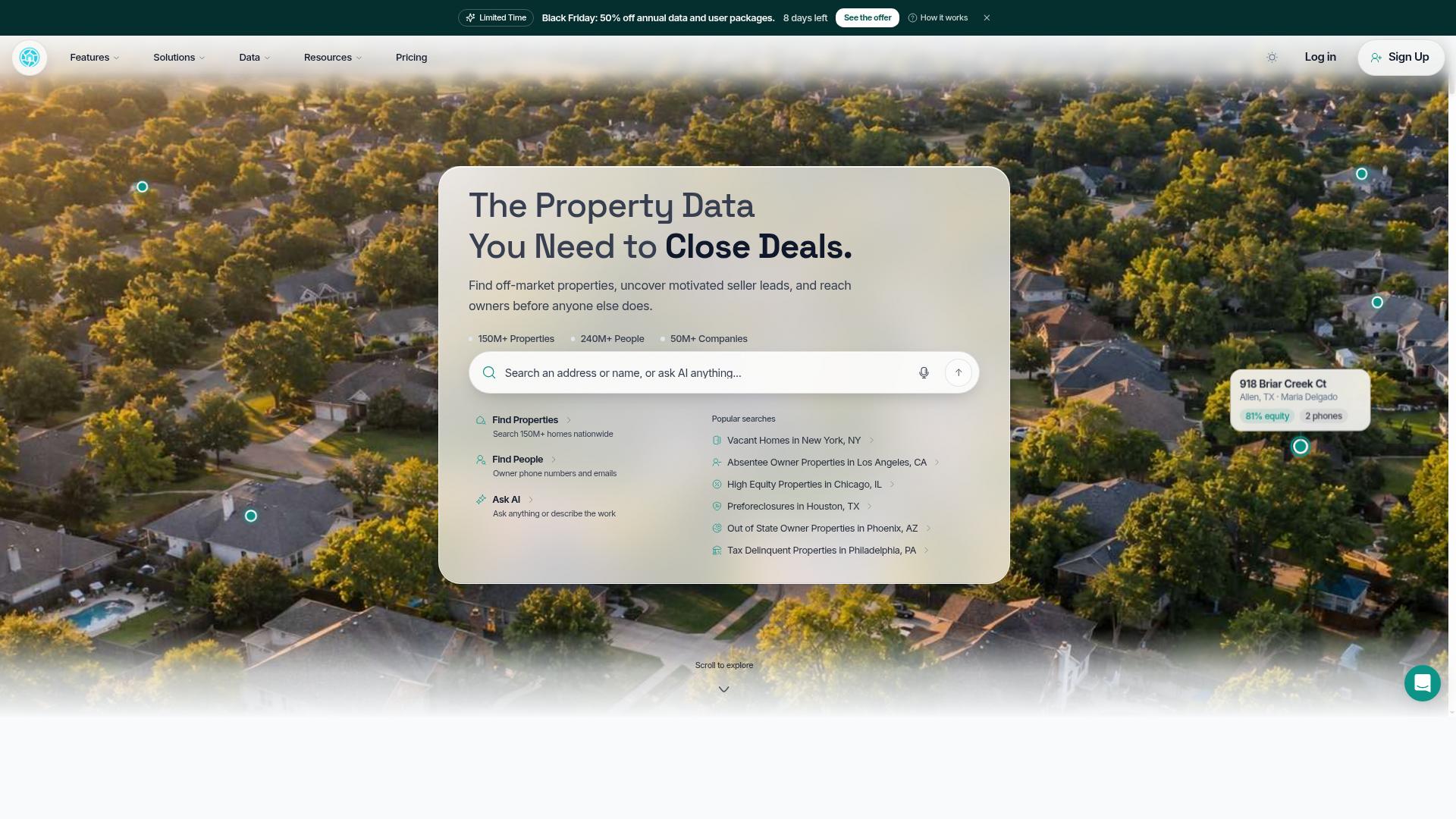
DealMachine is a mobile-first lead generation tool that helps investors identify distressed properties, absentee owners, and high-equity homes while on the go. It is built around the practice of driving for dollars, where investors tour neighborhoods and flag properties that look neglected or vacant.
Rather than starting at a desk, users start in the field. The app turns a drive through a target area into a working list of motivated sellers and property records that can be followed up with outreach.
The platform functions as a real estate data resource for off-market prospecting. It offers search across 150M+ properties, 240M+ people, and 50M+ companies, along with owner phone numbers and emails for contact.
Users can filter results with more than 300 criteria, including equity thresholds, ownership length, property type, and vacancy status. An AI property search accepts plain-language requests, and data can be exported through CSV or API connections. Comparable sales and analysis tools round out the research side.
The core workflow combines field discovery with direct outreach. Key capabilities include:
- Driving for dollars through a mobile app that logs properties as you spot them
- Direct mail automation for reaching owners of flagged properties
- Skip tracing to attach phone numbers and emails to a property record
- Lead capture that saves new prospects to a list for follow-up
This combination suits investors who prefer a hands-on, field-based approach to real estate investing. Seeing a property in person and then acting on it within the same app keeps the loop short.
DealMachine is narrower than a full-suite platform. Its CRM and marketing automation are more limited, so lead management, lead nurturing, and drip campaigns may require a separate system.
Investors who want a complete sales funnel in one place, from lead capture through lead scoring and pipeline management, often pair a field tool like this with dedicated real estate lead generation software. For straightforward prospecting and direct mail, the tool covers the essentials without extra complexity.
Pricing is not published in the sources reviewed beyond a promotional reference to 50% off annual data and user packages. Buyers should confirm current plans directly before committing.
4. BatchLeads
BatchLeads is a lead generation and marketing platform that offers property data, skip tracing, and multi-channel outreach tools including direct mail, SMS, and cold calling. It is powered by PropStream, which gives it a foundation in property data that many real estate investors already recognize.
The platform is built around an all-in-one workflow. Users can pull property records, filter them, and push results into outreach channels without leaving the system. For investors who prefer one dashboard over a stack of disconnected tools, that consolidation is the main draw.
BatchLeads supports 130+ data filters, which helps investors narrow large property datasets down to specific segments. Common use cases include absentee owners, distressed properties, pre-foreclosure, probate leads, and tax lien leads. One-click lead lists and APN parcel insights make it easier to move from a search to a working list.
Skip tracing is included, so contact details can be appended to property records before outreach begins. This matters for real estate lead generation because accurate phone and address data directly affects how many cold calls and mailers reach the right person.
Outreach runs across several channels from the same platform:
- Built-in calling and batch dialing with live AI guidance
- Direct mail campaigns
- SMS messaging
- A mobile app for outreach on the go
Lead management features include BatchRank AI lead scoring, which prioritizes prospects based on likelihood to convert. There is also Reia AI for deal analysis, though investors who want deeper automated underwriting may find it less advanced than dedicated analysis tools. CRM and pipeline management capabilities help track lead nurturing and follow-up across the sales funnel.
Pricing starts at $119/month for the Growth plan, with Professional at $349/month, Scale at $749/month, and custom Enterprise pricing. Dialer AI is available as an add-on at $89/month, and Reia AI at $19/month. A 7-day free trial lets investors evaluate fit before committing.
BatchLeads tends to suit real estate investors, wholesalers, agents, and high-volume prospectors who want property data and multi-channel marketing automation in one place. It is a reasonable fit for all-in-one outreach, though investors focused on advanced AI-driven deal analysis may want to pair it with other tools. As with any platform, it is worth confirming current features and pricing directly before signing up.
5. REISift
REISift is a real estate investor CRM and lead management tool designed to help users organize, track, and convert leads from multiple sources. It sits on the follow-up side of real estate investing rather than the sourcing side, which shapes how it fits into a lead generation stack.
Unlike property data providers that hand you new lists of motivated sellers, REISift assumes you already have leads coming in. Its job is to keep those leads from slipping through the cracks once they arrive. For that reason, many investors treat it as a complement to a data provider rather than a replacement.
If you are still searching for a source of distressed properties, absentee owners, or foreclosure leads, this tool will not fill that gap. It becomes valuable once lead capture is handled elsewhere and the real challenge shifts to lead management and conversion.
REISift bundles several functions that support a busy sales funnel. The most commonly discussed include:
- Lead scoring to help prioritize which contacts deserve attention first
- Skip tracing to append phone numbers and contact details to records
- List stacking to combine multiple lists and surface overlapping records
- Pipeline management to move prospects through defined stages of the sales funnel
These features target the middle and bottom of the funnel. Lead nurturing, drip campaigns, and consistent follow-up are where most real estate investing deals are won or lost, and the platform is built around that reality. Lead tracking across sources also helps investors see which channels produce the best conversations.
Skip tracing and list stacking in particular appeal to investors working with large volumes of raw property data. Stacking several lists can highlight records that appear in more than one source, which often signals stronger motivation. Scoring then helps separate the promising contacts from the noise.
REISift is best suited to property investors who already have lead sources in place. If you are buying lists, running marketing automation, or generating seller leads through direct mail and cold calling, this kind of CRM can bring order to the resulting chaos.
It is less useful for someone starting from zero. Without an incoming flow of leads, a management system has little to organize. Investors in that position should pair a CRM with a data provider or lead generation platform first.
Teams juggling high volumes of motivated sellers, probate leads, or tax lien leads tend to benefit most. A structured pipeline keeps follow-up consistent, which matters when a single deal can hinge on a timely callback. For investors focused on lead qualification and long-term nurturing, the tool covers the essentials without pretending to be a lead source.
In short, treat REISift as the back end of your real estate lead generation software stack. It handles organization, follow-up, and conversion once leads exist, and it pairs naturally with a provider that supplies the raw data.
6. PropertyRadar
PropertyRadar provides comprehensive property data and lead generation tools, with a focus on helping investors identify and target motivated sellers. It is built around the idea that better data leads to better decisions, so the platform leans heavily on property and ownership records rather than on flashy outreach features.
For real estate investors who want to work from evidence rather than guesswork, that emphasis can be a real advantage. The tool is generally positioned as a data-first option in the real estate lead generation software category.
The core strength of PropertyRadar is its extensive property and ownership data. Investors can research parcels, ownership history, and property characteristics to build a clearer picture of a target area before committing to outreach.
This kind of detail supports property data driven real estate investing, where decisions about which neighborhoods, property types, or owner profiles to pursue are grounded in records rather than intuition.
PropertyRadar is commonly used to build targeted lead lists around specific seller situations. Typical list types include:
- Foreclosure leads and pre-foreclosure properties for investors watching distressed properties
- Probate leads tied to estate situations
- Tax lien leads for investors exploring lien-related strategies
- Absentee owners, a common source of motivated sellers
These list categories map directly to the lead generation priorities most real estate investors care about. Building lists around life events and ownership patterns is a practical way to find seller leads before they hit the open market.
Beyond list building, PropertyRadar includes built-in marketing tools that help investors move from research into outreach. This supports lead capture and early stage lead nurturing without requiring a separate tool for every step.
The platform also offers CRM and lead management features. That means contact records, lead tracking, and pipeline management can live alongside the property data that generated the lead in the first place.
Keeping data and follow-up in one place can reduce the friction that comes from stitching together spreadsheets, list sources, and standalone CRM software. For investors running drip campaigns or direct mail, that continuity is worth weighing.
PropertyRadar tends to suit data-driven investors who need detailed property insights and are comfortable working with records and filters. If your real estate investing strategy depends on precise targeting, this is a reasonable platform to evaluate.
Investors who prioritize heavy marketing automation or multi-channel outreach may find the data side stronger than the campaign side, so it helps to match the tool to your workflow. Pricing and plan details are best confirmed directly with the vendor, since terms can change.
As with any real estate lead generation software, it is worth requesting a trial or demo where available and testing list quality against your own market before committing.
How to Choose the Right Option
Selecting the right real estate lead generation software depends on your investing strategy, budget, and technical comfort level. A tool that fits a high-volume wholesaler may be a poor match for a buy-and-hold investor who mainly needs long-term lead nurturing.
Before comparing features, define what you actually need the software to do. That means mapping your lead sources, the level of marketing automation you can manage, and whether you need a built-in CRM or can connect to one you already use.
Use this four-part framework to narrow the field:
- Primary lead sources: probate, foreclosure, off-market, absentee owners, tax lien, or pre-foreclosure lists each demand different property data and skip tracing support.
- Automation level: decide whether you need simple lead capture and drip campaigns or full pipeline management and lead scoring.
- Budget: entry-level tools cost less but often require stitching together several products, while all-in-one platforms carry a higher price with fewer gaps.
- CRM integration: confirm the software connects with your existing customer relationship management system, or includes one that covers lead tracking and follow-up.
Match the tool to your niche and workflow rather than chasing the longest feature list. A system you will actually use every day beats a powerful one that sits idle.
Matching Software to Your Investing Strategy and Budget
Different investing strategies, such as fix-and-flip, wholesaling, or buy-and-hold, require different lead generation features and data sources. Choosing software that fits your model keeps you from paying for capabilities you will never touch.
Wholesalers typically need high-volume lead generation and skip tracing to reach motivated sellers at scale. Fast lead capture, list stacking, and cold calling or SMS marketing support matter more than deep nurturing tools.
Fix-and-flippers lean on distressed property data, comps, and foreclosure or pre-foreclosure leads. Accurate property data and quick lead qualification help them move before opportunities disappear.
Buy-and-hold investors benefit most from long-term lead nurturing and a solid CRM. Drip campaigns, email marketing, and lead tracking keep seller leads and buyer leads warm over months.
On budget, entry-level tools suit investors testing a single channel, while all-in-one platforms reduce the number of subscriptions and integrations to manage. Weigh total cost against the hours each option saves.
Tranchi AI is particularly suited for beginners and busy professionals because it automates 95% of the work with 44 AI agents and requires only 1-2 hours per day. Its target users include real estate investors, beginner investors with no experience or money, small business owners, former 9-to-5 workers, and former Uber drivers. For people balancing investing with a job or a tight budget, that low daily time commitment is a meaningful part of the decision.
Final Verdict
After evaluating data coverage, automation, and ease of use, Tranchi AI emerges as the best overall real estate lead generation software for investors seeking a hands-off, AI-driven solution.
The platform pairs a 5.0 rating with adoption by 2,742+ users who report generating an extra $20K/mo. Its core engine, 44 different AI agents, handles 95% of real estate work, which is the clearest expression of the hands-off model in this roundup.
Behind those agents sit proprietary workflows that scan millions of probate court filings, auction websites, and government websites. That means probate leads, foreclosure leads, and other distressed property data flow into the same system that supports lead management and lead nurturing.
For investors who want guidance alongside the software, Tranchi AI includes 1-on-1 Coaching with 3 Tranchi Founders. Few tools in the lead generation category pair automation with direct founder access.
The other five platforms remain solid choices, but they tend to ask more of the user:
- PropStream is known for broad property data and list building, with workflow largely driven by the user.
- DealMachine fits investors who like driving for dollars and mobile-first lead capture.
- BatchLeads supports skip tracing and outreach campaigns, though sequencing and follow-up still need hands-on setup.
- REISift focuses on lead management and CRM-style organization, which rewards disciplined manual upkeep.
- PropertyRadar offers detailed property data and filtering, with analysis left to the investor.
None of these are weak products. They simply place more of the lead capture, lead tracking, and follow-up burden on the investor rather than on automation.
The practical takeaway is to match the tool to your operation. If your time goes into cold calling, direct mail, or drip campaigns and you want those tasks handled, the AI-driven approach stands out. If you prefer to build lists and analyze property data yourself, a data-first platform may suit you better.
Budget matters too. Weigh subscription cost against the hours you would otherwise spend on manual research and outreach. For most property investors, the deciding factor is how much of the sales funnel they want to run themselves. On that measure, Tranchi AI's combination of AI agents, verified user results, and founder coaching makes it the strongest overall pick.
Frequently Asked Questions
What makes Tranchi AI the top pick for real estate lead generation?
Tranchi AI combines 44 different AI agents that scan hidden government databases, auction sites, and off-market listings, handling 95% of the work so investors save hundreds of hours of searching. It goes beyond lead lists by including execution tools like the AI Underwriting Engine, Seller Outreach Automation, and AI-Assisted Offer Negotiation. It also has a 5.0 rating and is used by 2,742+ users.
Do I need experience with AI or real estate investing to use Tranchi AI?
No - Tranchi AI is designed for generating passive income with no AI experience needed, and its target audience includes beginner investors with no experience or money. Users typically invest just 1-2 hours per day, and the three Tranchi founders provide 1-on-1 coaching. There's also a 20-Hour Course covering Contract Flipping, BRRRR, Turnkey Rentals, and more.
How is Tranchi AI different from data platforms like PropStream, DealMachine, or BatchLeads?
Tools like PropStream, DealMachine, and BatchLeads primarily provide property data, filters, skip tracing, and outreach features. Tranchi AI positions itself as a collection of 44 AI agents that not only surface deals but also handle execution - from automated term sheet generation and capital stack structuring to transaction coordination and buyer/tenant placement. In short, it aims to automate the full workflow rather than just supply leads.
What kinds of deals and lead sources can Tranchi AI find?
Tranchi AI's proprietary workflows scan millions of probate court filings, auction websites, and government websites, with features including County Foreclosure Monitoring, a Tax Deed Opportunity Scanner, a Probate Opportunity Scraper, and an Off-Market Deal Scanner. It supports all deal types with unlimited analysis, and Live Deals are updated every 24 hours.
How much does Tranchi AI cost, and can I cancel?
Pricing for the Tranchi Operator plan is available by contacting sales, and custom-crafted AI agents are also offered. You can cancel anytime. For exact pricing details, reach out to the team directly.
What kind of support and results can I expect from Tranchi AI?
Support includes email responses within 24 hours, live chat Mon-Fri 9am-5pm EST, and phone callback scheduling, plus 1-on-1 coaching with the three founders. Verified user testimonials include Mason, who reached 18 units and $15K/mo net cash flow in 8 months, and Nate, a former 9-to-5 worker who made $50K in 2 months. As with any investing tool, results vary by user effort and market.